Photo courtesy of ITTF
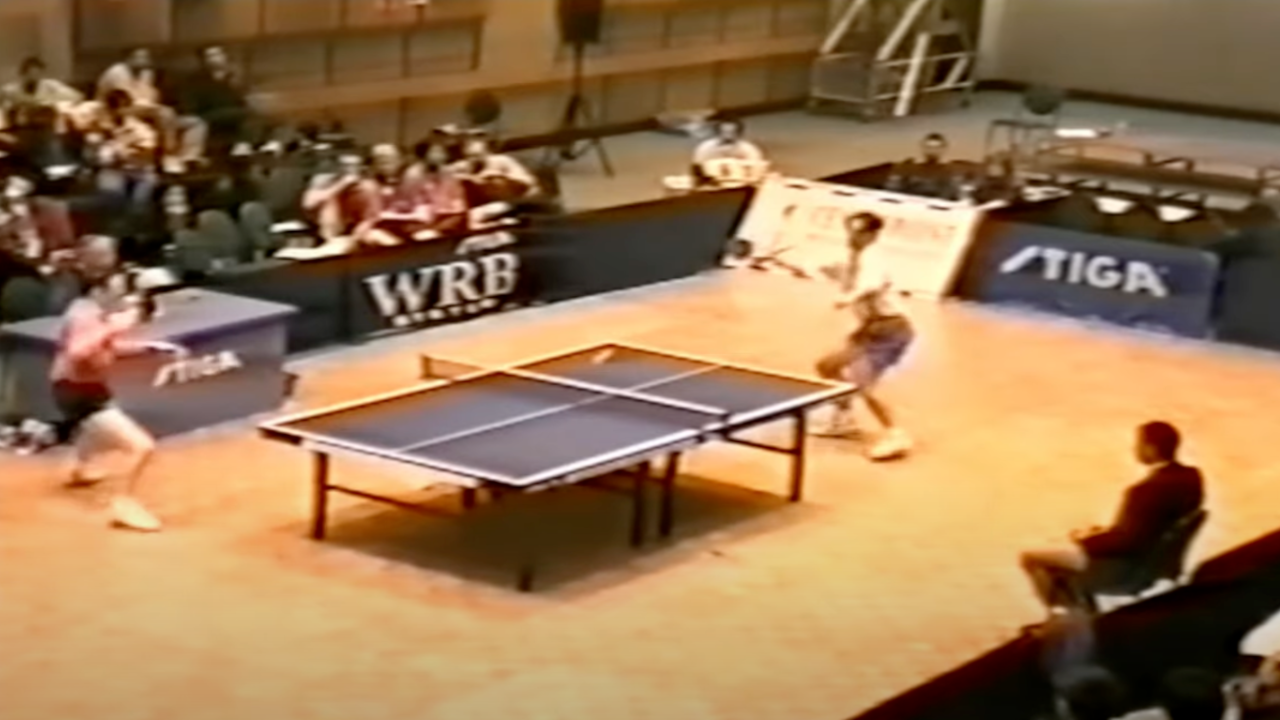
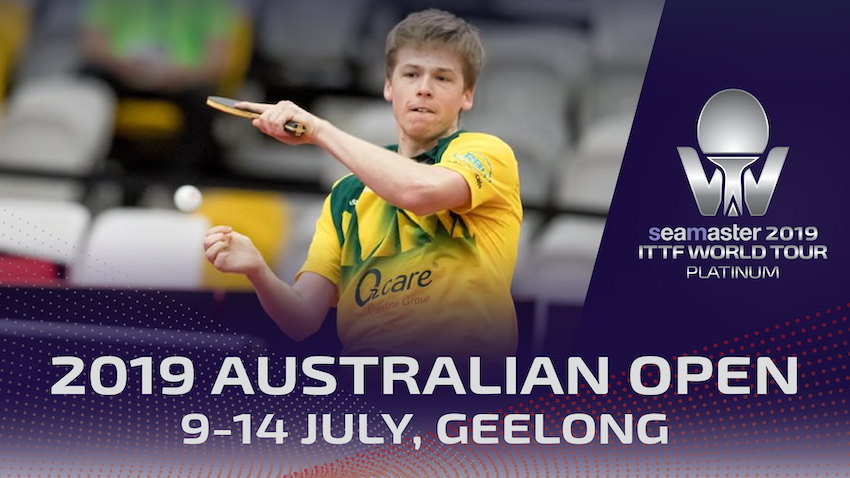
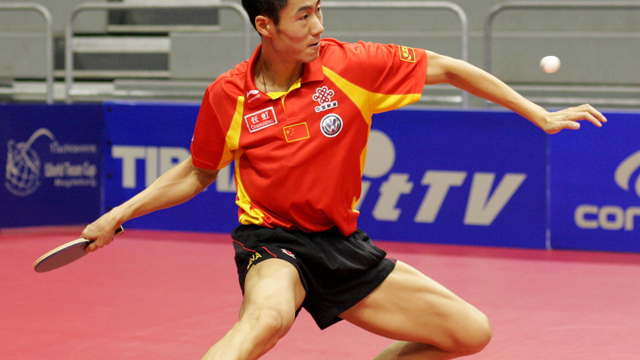
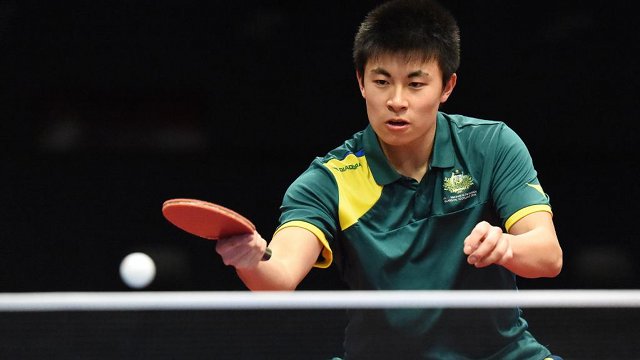
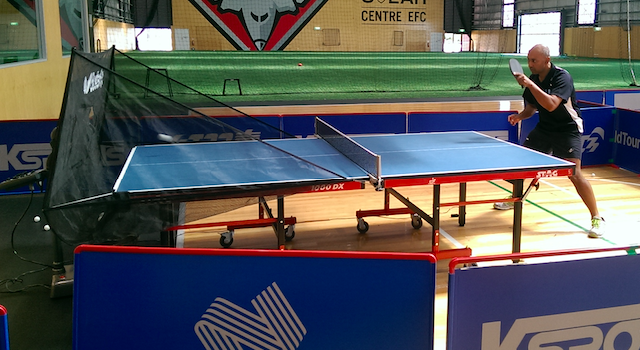
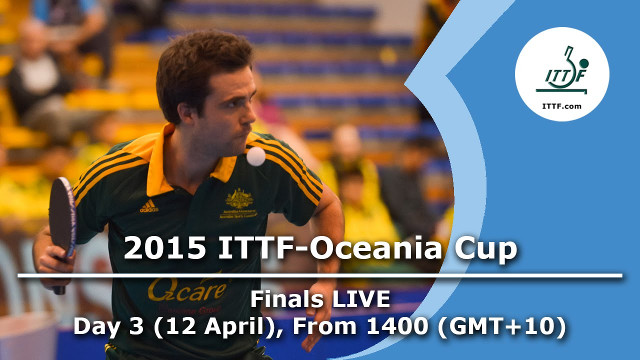
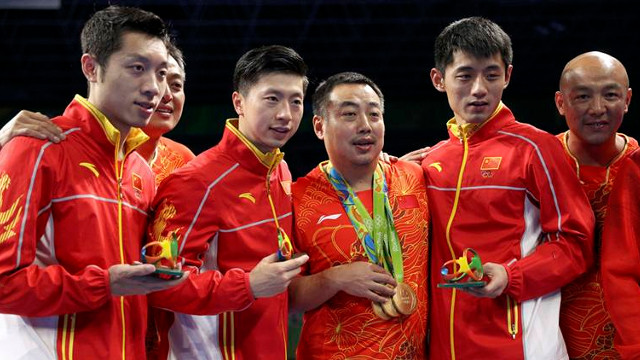
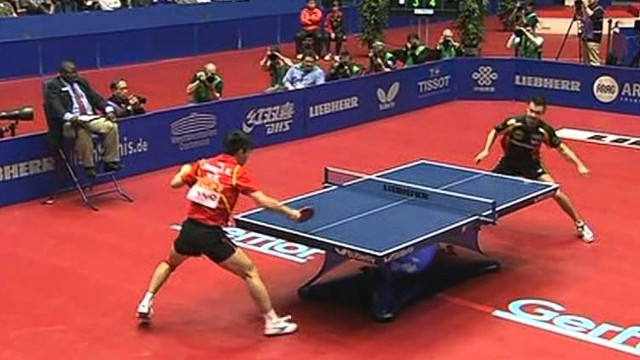
Mark Smythe in action at the Sydney Olympics
Discusssion Paper
The discussion paper presented here was written by Mark Smythe on the 4th February 2008 and has been presented to Table Tennis Australia. As of yet Mark has not received a response from Table Tennis Australia
The intention of this document is to give TTA (Table Tennis Australia) options to consider in regards to the direction it wishes to take in assisting the elite players of Australia.
Background Information
From 1987 – 2000 TTA had a National Training Program. The concept used was a National Training Centre and Victoria was the chosen State. Only players who were invited by TTA were permitted to train in these sessions. A Full-time National Coach was employed to run the program and coach the National Team during competition. There were no Junior or Cadet International Events throughout this period. For the majority of years, there was an assistance coach involved and I’m not sure how this was funded.
From 2001 – 2006 TTA had no organised National Training Program. No National Coach was employed on a full-time basis. The concept was “event coaches” and coaches for each event were selected. Junior and Cadet International Events commenced during this period.
Since 2007 TTA have a National Training Program. The concept used is multiple training centres and 4 states have been chosen. Since mid/late 2007 TTA have had a full-time National Coach.
Options
Three options to choose from are:
- One National Training Centre (same as 1987 – 2000)
- Multiple Training Centres (same since 2007)
- Not having a National Training program (same as 2001 – 2006)
Questions
- Does TTA want to improve International results?
- What does it take (re: competition and training) to be competitive or improve current results at International level?
- Is, having more or less players involved in a National Squad/Training Program a better option?
- Are financial resources being used in the most effective way?
Answering Questions
- TTA need to understand what is required by the players to improve its results on the International scene before answering this question. In fact, as the gap (re: standard) gets wider between us and the rest of the world, the present and future senior players will need to train the same amount but for more years than the answer to question 2
- Using past and present Australian Senior players who have been competitive at International level, the requirement would be, between 20-30 hours (competition and training – on table and physical) per week for most weeks of the year and for a minimum of 3-4 years.
For juniors, between 10-20 hours per week is required. This is based on knowing the programs of 2 top juniors I coach (David Powell and Lily Phan – both have won Australian Singles Titles) plus aware how much the best juniors (Kyle Davis, Robert Frank and Trent Carter) have played each week over last few years. It is unrealistic to expect juniors to play 20-30 hours per week during their school years and only logical during Year 12, play a minimum amount.
- Depending on how TTA answer question 1, should determine how this question is answered – mainly due to limited finances available.
In my mind, there will most likely be different outcomes (re: standard and depth of good/top players) for each option, therefore believe questions 1 and 3 are related and linked together.
- The most effective way for the financial resources to be used will depend upon what Option is chosen.
Discussing the Options
All options are based on; every registered Australian player permitted to make a National Team with certain training requirements adhered to once each Team has been, qualified for, or selected.
Ideas on “how to implement” and a set of “for” and “against” comments for each option will now be identified. This is working on the current budget available.
Option 1 - One National Training Centre
How to implement
- All financial resources to be used to operate the National Training Centre.
- The National Coach will run the program and an Assistant Coach shall be appointed.

- Only National Squad members are permitted to be part of these sessions unless approved by National Coach
- The State to hold the National Training Centre shall be the one which has the most National Squad Members. This is only logical, as to create minimal/reduced hassle in regards to players relocating.
- All States will be asked to operate and fund its own training program (including State which has National Training Centre). TTA can offer ideas (such as this document and relate it to State instead of National program) on how to run a program but each State can choose what is best for them. Intention is to create a pyramid system where the State programs will produce and feed players into the National program.
For
- Players have an opportunity to train 20-25 hours per week (7 - 8 sessions x 2.5 - 3 hours) which is a necessity for satisfactory improvement to be competitive at International level.
An observation - Since the completion of the Sydney Olympics (Oct. 2000) there has not been one Australian player (living in the country) who has trained at least one year of 20-25 hours per week for 45-50 weeks of the year. This coincides with TTA not having a National Training Centre, which ceased straight after the 2000 Olympic Games. Is this the reason or just a coincidence?
- National Coach able to work more often and closely with players at National Training Centre.
Against
- Unrealistic and too difficult for some/many players to relocate to the State where Training Centre is.
- Most likely will be less players involved in National program (week in, week out) and if some choose to play European/Asian Professional League then training partners can be difficult for National Coach to organise as there will be less depth – this was the case from 1997-2000 where there were 4-6 players each session and was one of the main reasons why the program eventually fell apart.
Option 2 - Multiple Training Centres
How to implement (as with current program)
- TTA choose X amount of States to run a program.
- Each State shall have one coach run its program with National Coach overseeing all aspects and visiting each program as often as possible.
- Only National Squad Members permitted to be involved in training sessions unless authorised by National Coach.
For
- More players involved in National training program.
- More coaches involved in National program – this is a lesser concern.
Against
- Realistic to expect players living in Australia not to improve their International results as less training hours are offered each week, therefore highly likely all/most players will train/play less (up to 15 hours) each week.
Option 3 - No Training Program
There shall be 2 options to choose from. They are:
- TTA having financial contracts with certain players – like Cricket Australia does with its’ annually reviewed National Squad.

- TTA send certain players overseas more often for training and competition for extended (minimum of 3-4 months at a time) periods of time.

Each option will be discussed separately
How to implement (option 3 - 1)
- TTA to offer contracts to National Squad members and see how many are interested - a minimum amount can be given as an indication if/when players asked how much money is involved.

- TTA shall offer varying contracts (re: remuneration) depending upon certain aspects such as,
- Standard (by results) of each player
- How often they will train
- How often they will assist in training when required by the National Coach.
- National Coach’s responsibilities include, focusing on contracted players, oversee other National Squad Members’ training/competition programs and organise (weekend, one week or two weeks) training camps when possible.
For (option 3 - 1)
- Contracted players will have the opportunity to play (training and competition) the necessary amount (20-30 hours per week) within and outside of Australia to improve level and results on International scene.
- Allows players to be paid for their services in assisting Australia improving on the International scene.
Against (option 3 - 1)
- Only a minimal amount of National Squad Members will receive assistance as priority will be given to those who are willing to travel overseas for extended periods of time.
How to implement (option 3 - 2)
- TTA to offer its National Squad Members the opportunity to train and compete more often overseas, then see how many are interested.
- National Coach to work closely with these players to plan their programs – which country/s to go to, when to go, how long to go for, what tournaments to compete in, etc. - , plus overseeing all other National Squad members’ training/competition programs and organising training camps (weekends – two weeks) when possible.
For (option 3 - 2)
- Allows players to play (training and competition) the necessary amount (20-30 hours per week) to improve level and results on International scene.
- Allows players to be paid for their services in assisting Australia improving on the International scene.
Against (option 3 - 2)
- Playing living and playing within Australia will not be given the opportunity to train the necessary amount to improve level on International scene.
- Will be less players involved in National Training Program.
My Opinion (Mark Smythe)
Background Information
As I have been involved on the National level since 1987 (when played my first Junior National Championships), lived and breathed the sport nearly everyday since 1991, believe I am very well qualified to make comment and have my comments carry a certain amount of weight when TTA discuss this topic. I went through varying stages which included,
- Playing 3 to 5 days per week for majority of school years (except Year 12 in 1990).
- Full time player (25-30 hours per week) from March 1991 – October 1996.
- Part-time player (15 hours per week) from October 1996 – June 1997.
- Casual player (train once per week and playing nearly every tournament possible in the State) from June 1997 – September 2000. It was through this period where I achieved my best results and had the 2nd best win of my career – 2000 Olympics defeated world number 58, Yan Chu Leung. I would not have been able to achieve these results without the 5 years of full-time playing done from 91-96.
As a player, I experienced all the highs and lows that come with playing sport, ranging from,
- Low grade club junior pennant, to, become Australian Under 15 and 17 Singles Champion.
- Playing full-time (25-30 hours per week) for two years (age 18 and 19) and unable to win a Men’s Open Singles event in Victoria, to, become Australian and Oceania Men’s Singles Champion 6 years later.
- Hating training as a junior, to, training 20-25 hours per week for 5 years and until recently was the only Australian male in at least 20 years to defeat 2 top 60 world ranked players at the time of playing them – the other player is now William Henzell.
- Missing out on qualifying for the 1996 Olympic Games by one spot (3rd), to, find out 2 months later that I was going due to New Zealand Olympic Committee refusing to send any male players.
- The only Australian male ever to defeat a Chinese National Team member in competition (Yan Sen at 1995 Swedish Open), to, cease playing full-time 10 months later (age 23) with only $1,000 to my name – all money I earned from working part-time was used to pay for, overseas trips, and general living expenses such as weekly board, buying a car, etc, etc.
- Withdrawn (after being selected) from a National Team (1996 Asian Championships) due to, not abiding by the criteria – minimum amount of training hours. Requirement was 15 hours per week for which I did except for 4 weeks where I trained 12 hours per week. This decision coincided with a new National Coach being employed and was the first Australian Team he was involved in. This is a similar situation to Stephanie Sang’s non selection for current Women’s Team to compete at World Team Championships in a few weeks.
- Not being selected in a National Senior Team (2000 Oceania Championships) when ranked no. 2, recent results were clearly good enough, made myself available and had already qualified for the 2000 Olympics which, was only 7 months away from this particular International event.
Key Aspects for a Successful Program/System
After seeing varying systems in place, the following aspects are the key ingredients to help create a successful long term program and a promising future for the sport in Australia and results internationally;
- More players competing and training
- More players competing and training more often
- Create fair and equal opportunities to make National Teams for major events (Olympic & Commonwealth Games and World Team Championships)
- Flexibility (re: training)
- National League to commence again
Discussing the Aspects
More players competing and training
I believe this is the most important aspect for long term success in regards to improving International results and having a healthy National program (competition and training).
The following statements (in regards to their player’s results) only back up and justify why this is the most important aspect as they all have the common aspect, which is more players competing and training compared to others in each statement,
- Victoria is the strongest and most successful State in Australia!
- Dandenong is the strongest and most successful (re: Juniors) Club in Australia!
- Mark Smythe is the most successful (re: Juniors) Coach in Australia!
(Information is provided at the end of this article to show these statements are correct).
In fact, if we look abroad and observe other countries that are above the Australian level, then this aspect is one of the biggest reasons why they are better. The end result of having more players playing is a higher standard at the top because the depth and standard of the 2nd, 3rd, etc, tier players will be greater and stronger.
If we take it even further and look to the best in the world (China), again it’s the same reason. Government funding and country’s population is also a big influence but the result is the same – more players competing and training creates a higher standard at the top.
Currently the sport is failing dismally in this aspect and should find ways to change it around. An example of how it’s failing is, observing the entries for the Team and Individual Event of each category’s (Senior, Youth and Junior) National Championships. The sport now needs “B” Teams (especially all female category’s) as to not embarrass itself for the Team Events – I actually support having “B” Teams but believe they should be a luxury and not a necessity. The Individual draws (for what is the biggest event of the year for each category) are smaller than many local tournaments in countries that are better than Australia.
TTA should communicate with successful countries, states, clubs and coaches to gather information and implement a system which will achieve the success it desires.
More players competing and training more often
TTA must provide the opportunity for players in the National Squad to train the amount of hours required to have the best chance to improve on the International scene – if that is one of its main goals.
Currently we have the best generation of young male players for at least 10 years but the National Training Program cannot offer the amount of hours per week necessary to go on and be competitive on the International Level as a senior player.
Also, there should be extra opportunities for our best players to compete against each other. For the best players of each state to compete against each other once to twice a year at National Championships is not enough! Having a National League can solve this problem which is mentioned previously.
Create fair and equal opportunities to make National Teams for major events
In order to keep more players playing (most important aspect) TTA needs to create as many situations where the players feel like there is a “fair” chance of making a National Team. History says, majority of Elite Australian adult players usually continue to play the sport for two main reasons. They are,
- Achieve individual goals, such as, making National Teams (for major events), therefore having opportunities of winning more matches at International Level, and becoming National and/or Oceania Champion.
- Earning/Winning money
As players can’t earn money (not even equivalent to only a part-time job) from playing within Australia, that only leaves one main reason left - achieving individual goals.
If the chance of making National Teams (for major events) is taking away from players (by selectors not selecting them for what could be a variety of reasons outside their results) then most will stop playing – history backs this comment up. As mentioned earlier, Australia currently has so few elite players that it cannot afford to lose any due to these reasons. If a player stops due to, him/her feeling they, are not good enough, lost interest in competing, etc, that is unfortunate but acceptable.
The only way to create the “fairest” system for players to make National Teams (including Junior and Cadet Teams) is to, have everyone permitted to make Teams (not just National Squad Members which is currently the case) and use Qualification Events for the major events.
Qualifying for a National Team allows each player to prove their abilities on the table and win the right matches at the right time. I can only think TTA would like to have players who can handle the pressure situations be representing the county at major International Events.
The positives are many, with the main one being, extending players careers, therefore giving the 2nd and 3rd tier players a greater chance to improve their standard by providing greater competition in tournaments and/or league. An example of this is Jian Fang Lay who was a full-time professional player in China before moved to Australia in 1993 or 1994. Jiang (career best of 47 on world ranking list) has continued to play tournaments nearly every year (missing most of 2003 and 2005 due to giving birth to 2 children) has helped improve the general standard of the women buy continuing to play tournaments and providing the opportunity of the domestic players to play her in competition. TTA should feel privileged such a top player has continued to play for so many years!
Flexibility re: training
Players go through many and varied situations during their career’s – as outlined with my own!
For TTA to create the best chance of having “more players competing and training”, it must be flexible with regards to, how many hours each player trains per week – competing is a separate issue.
It is logical that a player in the twilight of their career most likely doesn’t need to same amount of training as they did when younger and compared to other up and coming younger players.
I believe when dealing with majority of established Senior players who are in the twilight of their career (still National Team standard) the Coach should become more like a manager and treat each player independently according to, circumstances with their lives (employment, family etc.) and how often they can/want to train each week. Generally for players in this situation, competition is the main aspect which will help them improve (at worst maintain) their results.
National League to commence again
Background - National League commenced in the late 1970’s and ceased in the early-mid 1980’s. It then re-started in 1992 and ceased after the 1997 season. As mentioned earlier, players cannot earn money (same as a part time job) from competing in Australia!
A successful National League can, not only assist the players in this area, but, be a fantastic promotional tool to give the sport a higher profile – compared to the near non-existent one it has now – therefore creating more opportunities to gain sponsorships.
As indicated earlier, if there is a successful National League (includes players getting paid) operating then there is a greater chance of keeping more players in the sport.
For the TTA Board
I expect the Board will take this discussion paper seriously and advise a timeframe of when it will be discussed and a reply given.
I am available to discuss further with anyone interested or answer questions or be involved at a Board meeting (to answer any questions) if required.
Information to back statements
The following information is from 2006 and 2007 covering the most relevant age groups (Under 13, 15, 16, 18, 21 and Open) for a National Training Program.
Victoria is the most successful state in Australia!
- Most registered players in Australia.
- Most players who participate at each category’s Australian Championships.
- Most Australian Team Titles.
- Most Australian Individual Titles.
- Most Players ranked, Number 1 and in the Top 10, in Australia.
Detailed information is available on TTA website.
Dandenong is the most successful (re: juniors) club in Australia!
- Most players participating at State Junior Tournaments – usually 15-20.
- Most State representatives at Australian Junior Championships
- 2007 = 15 in Victorian Teams
- 2006 = 12 in Victorian Teams
- Best results at Australian Junior Championships
- 2007 = 5 of the 6 Singles Titles (by 3 players) which I don’t believe has ever been achieved by a Club, another player was runner-up in 2 Singles finals plus numerous Doubles Titles.
- 2006 = 1 of the 6 Singles Titles, 2 other players were runner-up in Singles finals plus numerous Doubles Titles.
-
- Most players ranked in the Top 10 covering all junior age groups
- 2007 = 12 (including the top 2 Under 15 & 13 Girls – same 2 players – and 4 of the top 6 Under 15 Boys).
- 2006 = 7
Mark Smythe is the most successful (re: juniors) coach in Australia!
Following statistics are from the players I coach individually (one on one) each week.
- Most players participating at State Junior Tournaments - usually 10-14.
- Most state representatives at Australian Championship
- 2007 = 10 in Victorian Junior Teams
- 2006 = 8 in Victorian Junior Teams
- Best results at Australian Junior Championships
- 2007 = One player won 2 Singles Titles, another player was runner-up in 2 Singles finals, 2 others were semi-finalist in Singles and 3 players won Doubles Titles.
- 2006 = 2 players won Singles Titles, another player was runner-up in Singles final, another player was semi-finalist in Singles and one player won a Doubles Title.
- Most players ranked in the Top 10 covering all junior age groups
- 2007 = 9 (including 50% of the Under 15 Boys)
- 2006 = 4 (including one at No. 1 and two at No. 2)
Your Opinion
Well that certainly is an interesting article from Mark but what are your thoughts? Make sure you leave a comment to tell everyone which option you think is the best and how it should be implemented.